

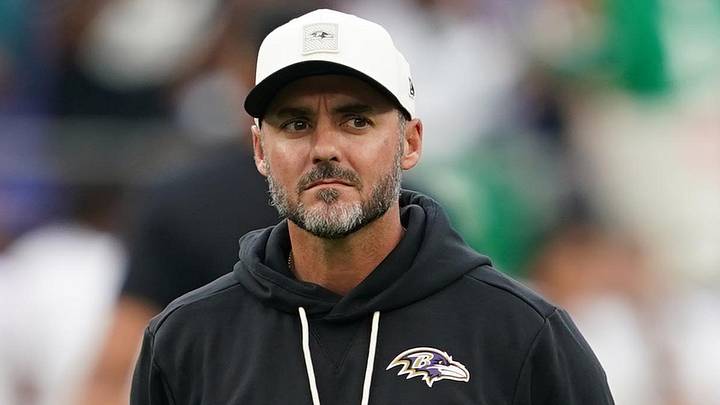
The Baltimore Ravens blew a lead to the New Orleans Saints in Week 2. After all the talk about John Harbaugh not being able to hold a lead over the last few years, Jesse Minter's team crumbled in the fourth quarter against the Saints.
It’s not entirely their fault, but the new coaching staff played a big part in Baltimore’s loss on Sunday. While players have to perform better and seize the moment down the stretch, the coaches have to make the right calls, put their players in a position to win, and help guide them through the tough stretches.
Whether it was Minter, Declan Doyle, Anthony Weaver, or Anthony Levine, they didn’t have the team flowing in the right direction after halftime. It was an instance of the opponent out-game-planning them once the third quarter kicked off.
These should just be growing pains, though…hopefully.
Baltimore Ravens’ loss vs. Saints is an expected speed bump under new coaching staff
Between the head coach and the three lead coordinators, the Ravens don’t have a coach older than 46 years old. Sure, they all deserve to be in the positions they’re in, but there’s a ton of youth on the staff.
Specifically, for the two lead play-callers on offense and defense, Jesse Minter and Declan Doyle have some work to do. Minter was a defensive coordinator just two years before making the leap into Baltimore’s head coaching vacancy, and 2026 is Declan Doyle’s first year calling plays. They’ll learn a lot this season.
For Minter, it felt like his defense went soft in the second half. Heck, even early on, you could tell the Saints were close to solving his defense, and they made the adjustments needed to crack the code in the second half.
The most back-breaking part for the defense? Allowing New Orleans to get comfortable on third and fourth downs. Tyler Shough and company went 8-for-15 on third, and 2-for-2 on fourth.
Minter also made a critical error in the fourth quarter. He challenged a Chris Olave catch with over 10 minutes to go, a play that had no chance of being overturned. He would lose that challenge, losing a critical timeout in the process. Had he not challenged, maybe Baltimore’s last-gasp drive would have ended differently.
As for Doyle, he couldn’t keep his guys firing on all cylinders coming out of halftime. Don’t get me wrong, the offensive line play was the biggest reason for their struggles, but Doyle failed to keep Derrick Henry rolling. That’s why everything started to unravel.
Henry only carried the ball five times in the second half, and while the Ravens had just four offensive drives in the second half, there were opportunities to keep Henry involved.
Doyle could’ve drawn up a Henry run on 1st-and-15 on Baltimore’s first three-and-out to get some yards back. Instead, they lost another three yards on a dump-off to Henry (largely due to more awful pass protection). More notably, the offense would’ve been wise to run Henry up the gut rather than firing deep for Chris Moore on 3rd-and-1 in the fourth quarter.
And the questionable coaching stems beyond Minter and Doyle, too. Anthony Weaver and Anthony Levine didn’t have their best moments.
Levine’s special teams unit was disastrous. The abysmal protection for Tyler Loop on his first field goal attempt allowed New Orleans to penetrate the interior and get just enough on it to push Loop’s kick wide right. And at the end of the first half, they allowed a huge return that basically handed the Saints a free three points.
Weaver’s mishap came off the field. During the practice week leading up to the game, Weaver called Shough a poor man’s Josh Allen. Obviously he meant it in a good way, but the New Orleans coaching staff used that as fuel, calling Shough “poor man” this past week. And well, he played like Allen in some ways. You can’t give guys that type of fuel—they’re going to find every way to use it.
Overall, the Ravens have what it takes to clean things up and get back to winning. No one should be questioning the new coaching staff for one game. A hiccup like Sunday was bound to happen. They need to get past these growing pains sooner rather than later, though.
 Add us as a preferred source on Google