

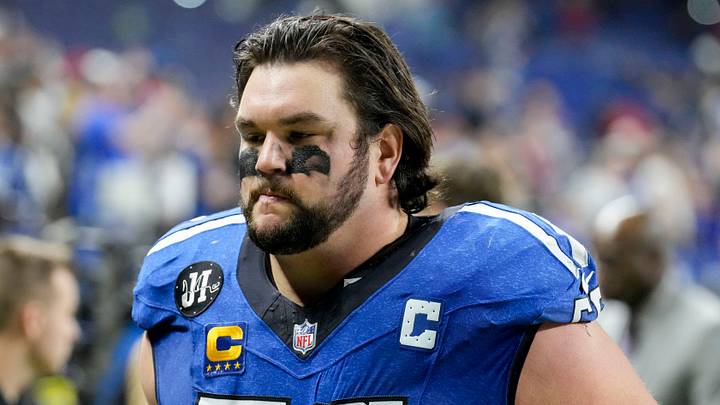
The Baltimore Ravens weren’t the team to land Quenton Nelson. That’d be the reigning Super Bowl Champion Seattle Seahawks. They dealt a 2027 third-round pick and a 2028 fifth-round pick to the Indianapolis Colts for the eight-time Pro Bowler.
Any team would be lucky to have a player like Nelson. He’s a future Hall of Famer, and honestly, Seattle may have gotten a steal — a third and fifth would be a bargain if they can extend him.
Baltimore’s offense could’ve used Nelson. They’ve endured what feels like endless offensive line struggles, and a guard duo of Nelson and Vega Ioane would’ve been elite. Unfortunately, the Ravens had too many hurdles to make this deal possible.
Baltimore Ravens had too big a mountain to climb to acquire Quenton Nelson
Quenton Nelson would’ve been a monstrous upgrade for the Ravens’ offense. Heck, that goes for any offense. He’s the best guard in the league; even if your team has two of the top guards, if you don’t have Nelson, there’s always room to improve.
Baltimore could’ve taken a leap if Nelson put on the black and purple. Current left guard John Simpson isn’t living up to his $30 million contract and is actually playing like one of the worst interior offensive linemen in the game. Nelson was really an obvious fit to take Declan Doyle’s unit to the next level.
It could just never come to be, though. Everywhere you look, there was some roadblock that kept a potential deal from becoming a reality. Even if Eric DeCosta was interested, the organization would’ve had to make several things work just to make it realistic.
The John Simpson problem
For as bad as John Simpson is, you’re not going to sign a player to a three-year, $30 million deal in the offseason, and trade for his replacement seven games into his 2026 campaign. I get it, Simpson’s an issue. You’re not going to bench a player making $10 million per year, though.
You could make the case that the Ravens could’ve traded Simpson in a deal for Quenton Nelson. But let’s be realistic: that’s just wishful thinking.
The Colts were looking for draft capital. When you’re heading toward a full-blown fire sale, you want every pick you can get — especially when the Colts don’t have a first-round pick this year. You don’t want a 29-year-old on a bad contract who probably has no future on your team.
And if Baltimore threw Simpson into a package, Indianapolis would’ve likely wanted extra draft capital to take the veteran off their hands.
Ultimately, the decision to sign Simpson helped close the door on bringing Nelson to Charm City.
The cap space problem
The Ravens are strapped for cash. They have about $2.6 million in cap space in 2026. Quenton Nelson would’ve cost $9.7 million.
Vice President of Football Operations Nick Matteo, who works with the team’s cap space, could’ve made it work. In that case, a few restructures had to be the money makers. Those being Marlon Humphrey, Roquan Smith, and Nnamdi Madubuike.
Here’s a look at the maximum cap savings from each restructure, per Over the Cap.
PLAYER | MAX RESTRUCTURE |
|---|---|
Marlon Humphrey | $13.46 million |
Roquan Smith | $9.35 million |
Nnamdi Madubuike | $15.58 million |
There’s an issue with all that, though. Restructures come at the cost of future cap space. You’re pushing money down the line that you’ll eventually have to pay for — it’s just a matter of when it catches up to you.
With Nelson needing an extension, that creates a whole separate issue. In that situation, the simple equation is backloading the contract, but even the 2027 cap space would’ve gotten tight regardless of how you iron out a contract — Baltimore is nearly $46 million in the hole right now.
Simply put, the math was always overwhelming.
The asking price
To be clear, the price for Quenton Nelson seemed rather cheap. I’m sure many teams that came calling offered something similar to a 2027 third-rounder and a 2028 fifth-rounder. The Ravens could’ve reached that price point.
But if there was interest, would other factors have made them think twice?
Remember, this team recently traded a 2028 second-rounder and 2027 fifth-rounder for Cam Jurgens. Dealing Day 2 picks in back-to-back years, and potentially back-to-back second-rounders, given Baltimore would’ve needed the Colts to eat some of Nelson’s salary, was an extra hurdle.
In the midst of that, you’re risking giving up a second- or third-round pick for a rental. Sure, you might’ve been able to trade for him, but could you have made the extension work?
Combine all of those ingredients, and there was never a realistic recipe to acquire Nelson.
 Add us as a preferred source on Google