

Whether they know it or not, the Ravens enter one of the most pivotal inflection points of the modern franchise era.
For nearly two decades, stability was the defining trait in Baltimore, from ownership to culture to the sideline presence of John Harbaugh. That stability is now gone.
But Harbaugh’s departure signals more than a coaching change -- it represents a philosophical crossroads. Do the Ravens lean further into offensive innovation around a generational quarterback, or do they attempt to preserve the defensive identity that has long defined the organization? That answer will shape everything that follows.
Ravens head into new era without John Harbaugh
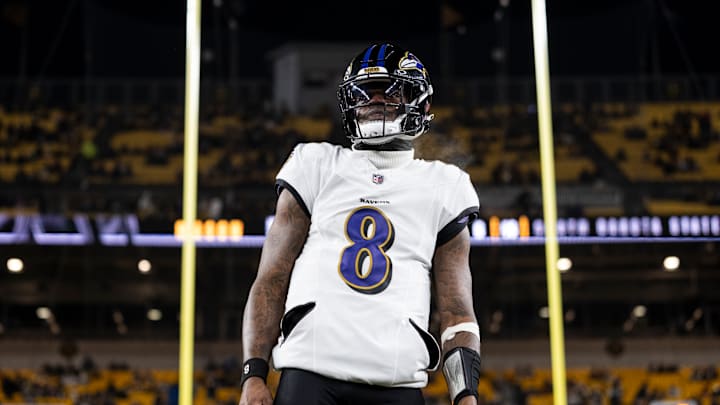
What remains clear, however, is that the Ravens still possess elite pillars on both sides of the football. And any retooling effort begins, and realistically ends, with Lamar Jackson.
Jackson, a two-time MVP, remains one of the most difficult players in the league to defend. His evolution as a passer has fundamentally altered how opponents structure game plans, while his legs continue to stress defensive integrity on every snap. Baltimore’s offense still flows through him, both schematically and emotionally.
Pairing Jackson with Derrick Henry, even at this stage of Henry’s career, gave the Ravens a physical identity that few teams could match. Henry is no longer a long-term building block, but his presence has mattered -- he sets the tone, shortens games, and forces defenses into heavier personnel, which in turn opens space for Jackson under center.
Up front, the Ravens have quietly assembled a younger, more malleable offensive line core.
Tyler Linderbaum remains one of the best centers in football and a foundational piece moving forward, Andrew Vorhees, a seventh-round pick in 2023, has become a legitimate contributor, a testament to his development, and Emery Jones Jr., a third-round pick out of LSU, has flashed as a guard, which will become increasingly important as Baltimore evaluates future roster turnover.
However, there are still questions. Daniel Faalele’s massive frame has not translated into consistent play at right guard, and Roger Rosengarten profiles more as a functional starter than a difference-maker. Developmental depth exists in Carson Vinson, the lone HBCU player selected in the 2025 draft, but the offensive line remains an area likely to see change as the new regime settles in.
At the skill positions, Zay Flowers remains the most dynamic wide receiver on the roster, capable of winning from varying alignments. Beyond him, the room is unsettled. Rashod Bateman’s future is unclear despite a recent extension, Devontez Walker remains unproven, and DeAndre Hopkins is a short-term veteran solution.
It's not a complete receiver room, and it may become a focal point in the next phase of roster building.
Defensively, Baltimore’s core still reflects the organization’s traditional strengths.
Up front, Nnamdi Madubuike anchors a versatile defensive line. His ability to absorb double teams while still disrupting plays should allow the Ravens to stay flexible with their pressure packages, while Travis Jones has quietly developed into one of the better young nose tackles in football, giving Baltimore legitimate interior stability.
At linebacker, Roquan Smith remains the heartbeat of the defense. And as long as he's healthy, Baltimore has a tone-setter in the middle. Around him, the youth movement is notable. Trenton Simpson’s role should continue to expand as a coverage-capable, sideline-to-sideline defender. Teddye Buchanan brings speed and range on the weak side, while Mike Green, a second-round pick in 2025, profiles as a long-term chess piece who can affect games in multiple alignments.
The secondary may be where Baltimore’s defensive future is brightest.
Kyle Hamilton is the headliner, and rightly so. Few defenders in football offer his positional versatility, instincts, and athletic profile. He erases mismatches, disguises coverages, and allows coordinators to be aggressive. Malaki Starks, a first-round pick in 2025, adds another versatile, high-IQ defender to the back end, capable of playing multiple roles. Then there's Nate Wiggins, who enters 2026 at a crossroads, having shown flashes but also inconsistency. His development will be critical in determining how aggressive Baltimore can be on the perimeter.
Overall, the Ravens are changing, but they aren't starting from scratch. With an elite quarterback, cornerstone defenders, and a culture that still values development, Baltimore’s 2026 outlook is less about rebuilding and more about redefining what the next era is supposed to look like.
 Add us as a preferred source on Google